

In manufacturing, quality control (QC) is always important—but in the automotive industry, it becomes mission-critical.
A minor defect in furniture manufacturing may lead to customer dissatisfaction. A defect in consumer electronics may cause product returns. But in automotive manufacturing, even the smallest deviation in a component’s geometry, material properties, software logic, or assembly tolerance can directly impact passenger safety, regulatory compliance, and brand reputation.
This is why automotive quality control operates under much stricter standards than most other industries. With increasing vehicle complexity—especially in EVs, ADAS systems, and software-defined vehicles—QC is no longer limited to dimensional inspection or end-of-line testing. It now spans mechanical engineering, embedded software, electronics, and system-level validation.
For manufacturers, suppliers, and engineering teams, understanding these differences is essential to building safer, more reliable vehicles while remaining competitive in a fast-changing market.
Why Is Quality Control More Critical in Automotive?
The automotive industry faces a unique combination of risks:
- Safety-critical product failures
- Strict regulatory requirements
- Massive recall costs
- Highly interconnected supply chains
- Long-term durability expectations
A single defect in braking systems, battery modules, steering components, or control software can trigger large-scale recalls costing millions of dollars, not to mention legal liability and reputational damage.
This is why automotive manufacturers must build quality into every stage—from design and simulation to production and supplier management.
1. Higher Safety Requirements and Direct Risk to Human Life
The biggest difference between automotive QC and many other industries is simple: failure can cost lives.
Automotive components must operate reliably under extreme real-world conditions:
- High-speed impact
- Thermal fluctuation
- Vibration and fatigue
- Moisture and corrosion
- Long operating lifecycles
Even microscopic defects can become critical over time. A weld imperfection, tolerance stack-up, or software timing issue may remain invisible during assembly but cause catastrophic failure in operation.
Because of this, automotive QC emphasizes defect prevention, not just defect detection.
Manufacturers increasingly use advanced engineering validation methods to identify failure risks before physical production begins.
2. Automotive Requires Specialized Quality Standards
Unlike many general manufacturing sectors that primarily follow ISO 9001, automotive companies must comply with highly specialized quality frameworks such as:
- IATF 16949
- PPAP (Production Part Approval Process)
- FMEA (Failure Mode and Effects Analysis)
- MSA (Measurement System Analysis)
- SPC (Statistical Process Control)
- ASPICE (for software quality)
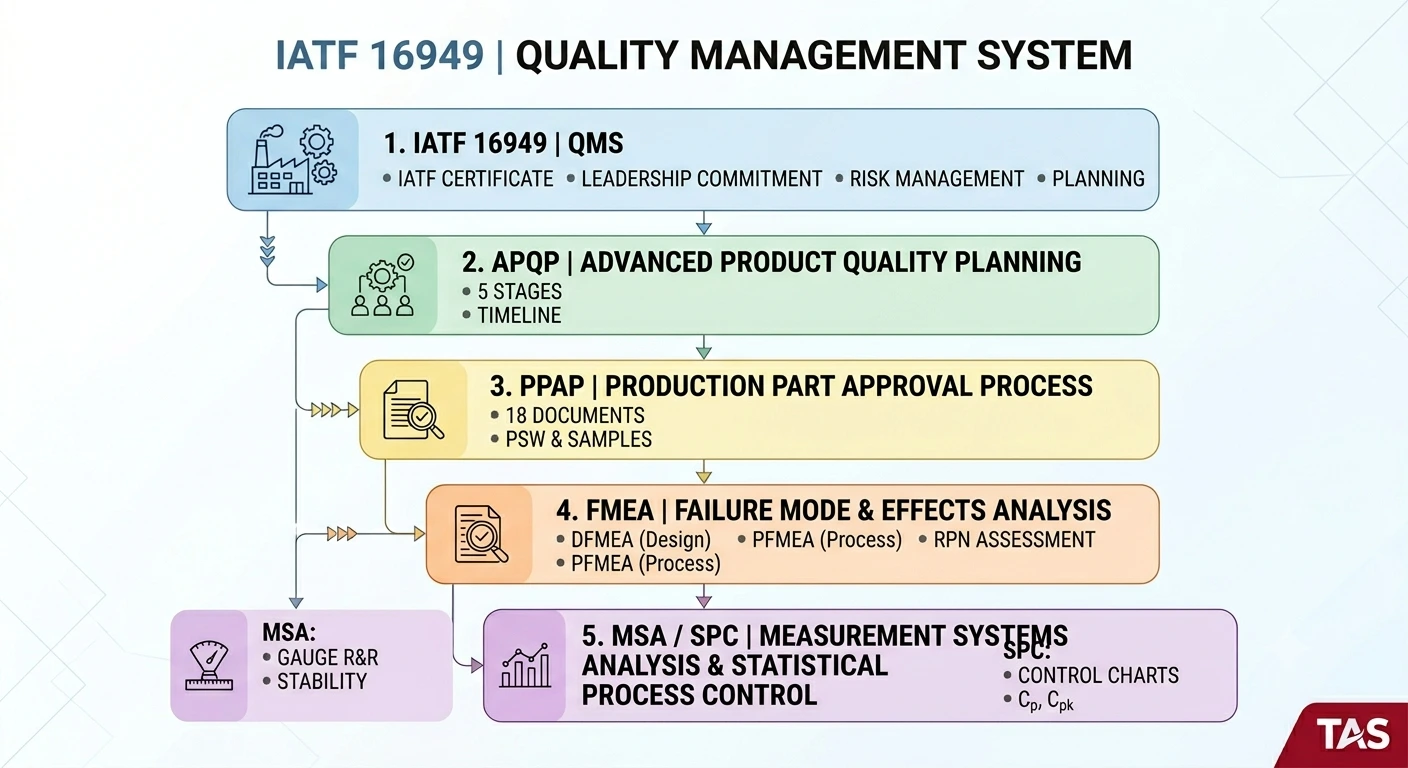
These frameworks create standardized processes for validating design intent, manufacturing capability, measurement reliability, and supplier consistency.
For example:
- FMEA helps predict possible failure modes early
- MSA validates whether inspection systems are accurate
- SPC monitors process variation in real time
- PPAP proves a supplier can consistently meet production requirements
This structured approach makes automotive QC significantly more rigorous than in most conventional manufacturing sectors.
3. Strict Traceability Across the Entire Supply Chain
Modern vehicles contain thousands of parts sourced from global supplier networks.
This creates a major quality challenge: full traceability.
Automotive manufacturers must track:
- Material batches
- Supplier origin
- Production lot numbers
- Machine parameters
- Inspection history
- Engineering change records
When a defect is discovered, traceability enables rapid root-cause analysis and minimizes recall scope.
In many industries, batch-level traceability is sufficient. In automotive, manufacturers often require component-level traceability for safety-critical parts.
This is especially important for:
- Battery systems
- Electronic control units (ECUs)
- Sensors
- Powertrain components
4. Quality Control Extends Beyond Mechanical Parts
Traditional manufacturing QC often focuses on dimensional accuracy and physical defects.
Automotive QC is far more complex because vehicles are now deeply integrated mechatronic systems combining:
- Mechanical components
- Electronics
- Embedded software
- Sensors
- Communication systems
As a result, quality control must validate not only hardware performance but also software behavior and system integration.
Examples include:
- Sensor calibration
- ECU communication validation
- Functional safety testing
- Software fault response verification
A mechanically perfect component can still fail if software logic behaves incorrectly.
This shift is one of the biggest reasons automotive quality assurance now requires multidisciplinary engineering expertise.
5. Long-Term Performance and Durability Matter More
Automotive products are expected to perform reliably for years under demanding operating conditions.
This creates a strong focus on durability validation such as:
- Fatigue testing
- Thermal testing
- Vibration testing
- Crash simulation
- Lifecycle testing
Unlike short-life consumer products, vehicles must maintain performance over long service intervals.
This makes predictive engineering especially valuable.
Instead of relying only on physical prototypes, manufacturers increasingly use simulation to predict failures before production.
How Engineering Platforms Strengthen Automotive QC
Modern automotive QC is heavily supported by advanced digital engineering platforms.
CAD: Better Design Accuracy and Traceability
Computer-aided design enables engineers to design components with tighter tolerance control and standardized specifications.
Benefits include:
- Reduced tolerance mismatch
- Accurate BOM generation
- Better design revision control
- Improved traceability documentation
A well-structured CAD workflow reduces downstream manufacturing issues significantly.
CAE: Predict Failure Before It Happens
Computer-aided engineering plays a major role in preventive quality control.
Using CAE simulation, manufacturers can evaluate:
- Structural strength
- Crash performance
- Thermal behavior
- Fatigue life
- Vibration response
This enables engineering teams to detect weaknesses before prototype manufacturing.
Benefits include:
- Fewer physical prototypes
- Lower testing cost
- Faster design iteration
- Improved safety performance
For automotive suppliers, CAE is becoming essential for reducing validation cycles and improving compliance readiness.
CAM and Automation: Stable Production Quality
Even a perfect design can fail if production processes vary.
CAM and manufacturing automation help ensure consistent production quality by improving machining precision and reducing operator variability.
Key benefits:
- Higher repeatability
- Reduced process variation
- Better SPC performance
- Real-time quality data collection
Automation also enables immediate anomaly detection, reducing scrap and rework.
BIM for Factory and Inspection Workflow Optimization
While BIM is commonly associated with construction, it also brings value in factory planning and operational efficiency.
In automotive production environments, BIM helps optimize:
- Equipment layout
- Inspection stations
- Asset management
- Maintenance planning
This improves inspection flow and supports efficient quality operations.
Automotive QC vs Other Manufacturing Industries
| Criteria | Automotive | Consumer Electronics | General Mechanical Manufacturing |
|---|---|---|---|
| Safety Risk | Extremely high | Medium | Medium |
| Mandatory Standards | Very strict | Moderate | Moderate |
| Software Validation | Extensive | Partial | Limited |
| Traceability | Highly detailed | Moderate | Basic to moderate |
| Supplier Control | Extremely strict | Moderate | Moderate |
The comparison makes one thing clear: automotive quality control demands significantly more engineering discipline, process control, and validation depth.
How TAS Vietnam Supports Automotive Quality Excellence
At TAS Vietnam, quality is not treated as a final inspection step—it is embedded across the engineering lifecycle.
By integrating CAD, CAE, CAM, and automation capabilities, TAS helps automotive manufacturers improve product reliability while reducing validation costs.
Examples of value delivered include:
- Using CAE to reduce prototype testing and accelerate design verification
- Improving machining precision through CAM optimization
- Increasing production repeatability with automation systems
- Supporting quality data collection for SPC-driven manufacturing
This integrated engineering approach helps manufacturers:
- Shorten time-to-market
- Reduce recall risk
- Improve compliance readiness
- Strengthen supplier capability
As automotive systems become more software-driven and electrically complex, advanced engineering support becomes increasingly critical to achieving world-class quality.
Conclusion
Quality control in automotive is fundamentally different from quality control in most manufacturing sectors.
It demands stricter standards, deeper traceability, multidisciplinary validation, and stronger process control. As vehicles continue evolving toward electrification and autonomy, QC will become even more engineering-driven.
Manufacturers that invest in digital engineering capabilities today will be better positioned to deliver safer, more reliable products tomorrow.
Need to strengthen your automotive quality workflow?
Contact TAS Vietnam to explore CAD, CAE, CAM, and automation solutions for next-generation automotive quality control.
No responses yet