Protect Occupants. Reduce Injury Risk. Validate Safety Before Physical Testing.
Passing a vehicle crash test is only part of the safety challenge. The real measure of success is how effectively the vehicle protects drivers and passengers during a collision.
Occupant Safety Analysis evaluates the interaction between vehicle structures, restraint systems, and human occupants during crash events. Using advanced CAE simulation technologies, manufacturers can predict injury risks, optimize safety systems, and improve occupant protection long before physical prototypes are built.
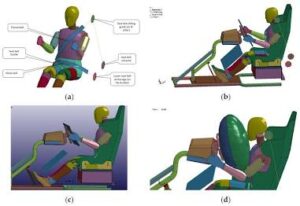
At TAS US, we perform virtual occupant safety simulations that accurately recreate real-world crash scenarios. By integrating digital human models and crash test dummies into detailed finite element analyses, we assess how occupants move during impact, how forces are transferred throughout the body, and where potential injuries may occur.
This allows engineering teams to identify safety issues early, improve design performance, and achieve regulatory compliance with significantly lower development costs.
Our Occupant Safety Analysis Capabilities
Occupant Kinematics Evaluation
We analyze how drivers and passengers move throughout a collision event, including body motion, contact points, and overall occupant behavior inside the cabin.
Airbag Deployment Optimization
Proper airbag timing can mean the difference between protection and injury. We evaluate deployment sequences, inflation characteristics, and occupant interactions to maximize effectiveness during impact.
Seat Belt Performance Assessment
Our simulations verify seat belt load distribution, pretensioner performance, restraint effectiveness, and occupant retention under various crash conditions.
Interior Impact Analysis
We identify potential injury risks caused by steering wheels, instrument panels, door trims, center consoles, pillars, and other interior components that may come into contact with occupants during a crash.
Injury Prediction & Assessment
Using industry-standard injury criteria, we evaluate potential risks to:
- Head
- Neck
- Chest
- Abdomen
- Pelvis
- Femur
- Lower Extremities
This helps manufacturers understand whether occupant protection targets are being achieved before expensive physical testing begins.
Regulatory & Safety Standard Support
Our virtual simulations support development programs targeting major global safety requirements and consumer safety ratings, helping engineering teams prepare for certification and validation activities with greater confidence.
Benefits of Occupant Safety Simulation
Reduce Physical Prototype Costs
Discovering occupant safety issues during physical crash testing can result in costly redesigns, delayed programs, and repeated validation cycles. Virtual simulation allows these issues to be identified much earlier when changes are faster and more affordable.
Accelerate Vehicle Development
Evaluate multiple design alternatives in parallel and make informed engineering decisions without waiting for prototype builds.
Improve Passenger Protection
Optimize airbags, seat belts, seats, and interior components to minimize injury risks and enhance overall occupant safety performance.
Increase Confidence Before Certification
Enter physical crash testing with a more mature and validated design, reducing uncertainty and improving the likelihood of achieving safety targets.
Support Design Optimization
Virtual testing enables hundreds of design iterations that would be impractical or impossible using physical crash tests alone.
Why Choose TAS US for Occupant Safety Analysis?
At TAS US, we combine advanced CAE expertise with practical automotive engineering knowledge to help manufacturers improve occupant protection while controlling development costs.
Our engineers support vehicle OEMs, suppliers, and product development teams with:
- Occupant Safety Analysis
- Crashworthiness Simulation
- Airbag and Seat Belt Optimization
- Injury Assessment
- Virtual Crash Testing
- CAE Consulting Services
Whether you are developing a new vehicle platform, validating safety systems, or preparing for regulatory testing, our simulation-driven approach helps you reduce risk, improve safety performance, and bring products to market faster.
Build Safer Vehicles with Virtual Occupant Safety Analysis
Protecting occupants begins long before the first physical crash test. Through advanced occupant safety simulation, manufacturers can identify risks earlier, optimize protection systems, and deliver safer vehicles with greater confidence.
Contact TAS US today to learn how our Occupant Safety Analysis services can help accelerate your vehicle development program while improving passenger safety.
No responses yet