Pedestrian Safety Simulation: Design Safer Vehicles Before the First Prototype Is Built
A pedestrian safety issue discovered during physical crash testing can become one of the most expensive setbacks in vehicle development. Failed certification tests, delayed product launches, tooling modifications, and engineering redesigns can add months to development schedules and significantly increase costs.
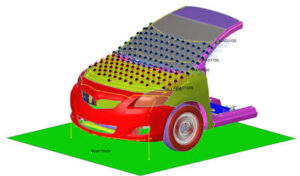
At TAS US, we help automotive manufacturers identify and eliminate these risks early through advanced Pedestrian Safety Simulation services. Using high-fidelity CAE simulation, we evaluate vehicle front-end performance under pedestrian impact scenarios, allowing engineering teams to optimize safety, improve regulatory compliance, and reduce dependence on costly physical testing.
Our simulation-driven approach enables safer vehicle development while accelerating time-to-market.
Why Pedestrian Safety Matters in Modern Vehicle Design
As global safety standards continue to evolve, pedestrian protection has become a critical requirement for vehicle manufacturers worldwide.
Organizations such as Euro NCAP, US NCAP, UNECE, and other regulatory bodies place increasing emphasis on pedestrian injury prevention. Vehicles that achieve strong pedestrian safety ratings not only meet compliance requirements but also strengthen brand reputation and consumer trust.
When a pedestrian is struck by a vehicle, seemingly small design factors can significantly influence injury severity:
- Hood geometry and energy absorption characteristics
- Bumper stiffness and impact response
- Windshield and A-pillar design
- Front-end structural load paths
- Material selection and deformation behavior
Through Computer-Aided Engineering (CAE), these factors can be analyzed and optimized long before physical prototypes are available, reducing development risk and enabling data-driven design decisions.
Our Pedestrian Safety Simulation Capabilities
TAS US provides comprehensive pedestrian impact simulation services to support vehicle safety development programs from concept design through validation.
Head Impact Analysis
Head injuries represent one of the most critical concerns in pedestrian collisions.
Our simulations evaluate how the hood, hood inner structure, windshield, and surrounding components absorb and distribute impact energy. We identify high-risk areas and recommend design improvements to reduce head injury criteria (HIC) values and improve overall safety performance.
Lower Leg and Bumper Impact Simulation
The lower extremities are often the first point of contact during a pedestrian collision.
We simulate bumper-to-leg interactions to evaluate:
- Tibia acceleration
- Knee bending behavior
- Shear displacement
- Force transmission pathways
These studies help optimize bumper systems and front-end structures to minimize injury risks.
Front-End Structure Optimization
Vehicle front-end architecture plays a critical role in managing pedestrian impact energy.
Our engineering team evaluates and refines:
- Hood systems
- Bumper beams
- Energy absorbers
- Front-end modules
- Structural reinforcements
The objective is to achieve the optimal balance between pedestrian protection, structural integrity, manufacturability, and cost.
Regulatory Compliance Assessment
We conduct virtual assessments against industry-recognized standards, helping manufacturers prepare for official certification testing.
Our simulations support development programs targeting:
- Euro NCAP Pedestrian Protection
- US NCAP Safety Requirements
- UNECE Regulations
- OEM-specific safety targets
- Global vehicle safety programs
By identifying potential compliance issues early, manufacturers can significantly improve first-time pass rates during physical validation.
Benefits of Pedestrian Safety Simulation
Reduce Development Costs
Physical crash testing requires expensive prototypes, specialized facilities, and extensive engineering resources.
By validating designs virtually, manufacturers can evaluate multiple design alternatives before investing in prototype builds, reducing overall development expenses.
Detect Safety Risks Earlier
The earlier a design issue is discovered, the less expensive it is to correct.
Simulation enables engineering teams to identify pedestrian protection weaknesses during the digital development phase, avoiding costly late-stage redesigns.
Accelerate Time-to-Market
Traditional test-and-redesign cycles can slow vehicle programs significantly.
CAE-driven development allows rapid iteration, faster decision-making, and shorter validation cycles, helping manufacturers meet aggressive launch schedules.
Improve Safety Ratings
Strong pedestrian safety performance contributes directly to higher safety ratings and stronger market positioning.
Simulation helps optimize vehicle designs to achieve better performance in official safety assessments while improving real-world pedestrian protection.
Why Choose TAS US
At TAS US, we combine advanced CAE expertise with practical automotive engineering experience to deliver simulation results that support real-world design decisions.
Our team helps automotive OEMs, Tier 1 suppliers, and mobility innovators:
- Improve pedestrian safety performance
- Reduce physical testing requirements
- Meet global regulatory standards
- Accelerate product development
- Lower engineering and validation costs
Whether you are developing a passenger vehicle, commercial vehicle, electric vehicle, or next-generation mobility platform, TAS US provides the simulation expertise needed to build safer and more competitive products.
Build Safer Vehicles with Confidence
A pedestrian safety issue discovered in a virtual model can be corrected in hours. The same issue discovered during physical crash testing can cost months of delays and substantial redesign expenses.
With TAS US Pedestrian Safety Simulation Services, you can identify risks earlier, optimize vehicle performance, and achieve compliance with confidence—before the first prototype ever reaches the test track.
Contact TAS US today to discuss your pedestrian safety simulation requirements and accelerate the development of safer, smarter vehicles.
No responses yet